

November 16th, 2026
Listen to Episode on:


Watch the Unabridged Interview:
Order Books
Navigating Technology and Cognitive Control Beyond the Screen
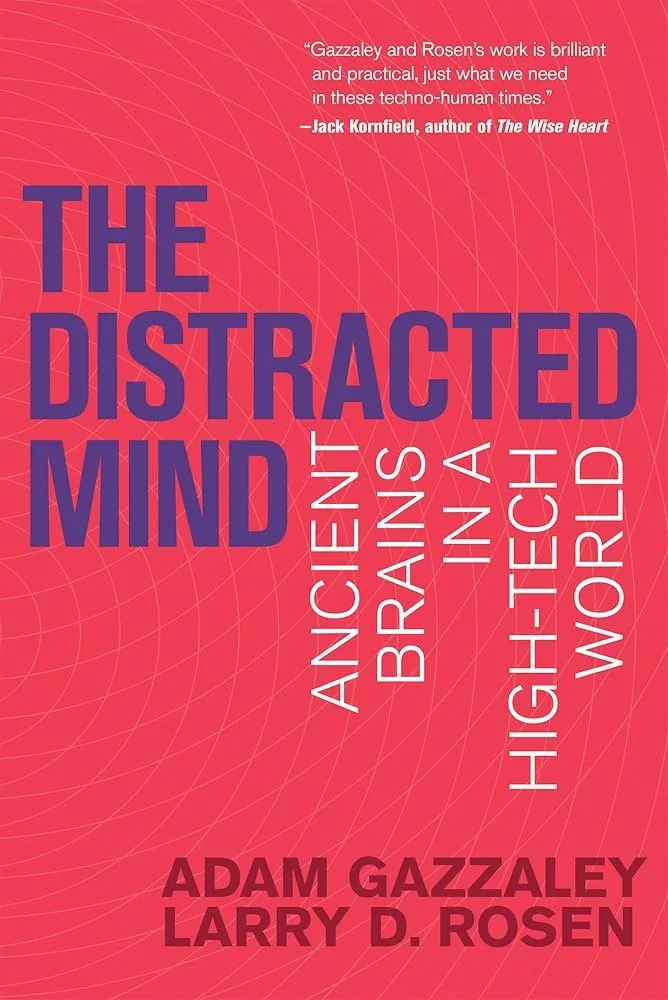
Adam Gazzaley is a professor at UCSF running the Neuroscape lab. He’s also the co-founder of Akili Interactive Labs and also the co-author of the book, The Distracted Mind: Ancient Brains in a High-Tech World.
Greg and Adam discuss why the book’s neuroscience of attention and interference remains valid while modern technology has intensified distraction and reward cycles. Adam explains human cognitive control and goal-setting, the prefrontal cortex’s role in top-down regulation, and how information overload and multitasking create goal interference. He distinguishes attention from working memory and goal management, and describes research showing that focus and suppression are dissociable, with aging linked to reduced suppression and increased distraction.
They also discuss contextual attention (like in games), information foraging and switching costs, shrinking content and rapid rewards, anxiety and boredom around devices, and using intentional training (including video-game-based interventions) to strengthen cognition across the lifespan.
unSILOed Podcast is produced by University FM.
Episode Guide:
00:00 Why Distraction Got Worse
03:10 Human Goals and Interference
06:11 The Pause Between Stimulus
08:35 Prefrontal Control Network
09:50 Attention, Memory, Goal Management
11:03 Focus Versus Suppression
12:35 Aging Filtering Breakdown
17:00 Internal Distraction and ADHD
20:45 Anxiety, Boredom, and Phones
22:49 Information Foraging Theory
26:23 Why Multitasking Fails
29:12 Switching Biases and Algorithms
33:41 Fighting Distraction Habits
37:29 Training Attention Like Fitness
39:50 Plasticity Across the Lifespan
41:51 Transfer to Working Memory
44:24 Kids Tech and Future Regrets
47:06 Wrap Up and Takeaways
Episode Quotes:
The hidden cost of multi-tasking
28:35: The cost that you pay with switching, that's like the real rub, right? ‘Cause if you were just switching versus multitasking, that's like an academic thing. Who cares? But the idea of parallel processing is that they're both going on at the same level that they were occurring when you were single-processing. But the switching leads to a cost, like a loss of fidelity of that information that was in one stream when you move to the other that it has to recapture, and that costs us in time and in accuracy, and that's what presents itself and creates sort of this less productive mode of multitasking.
Why technology's a two-sided sword
38:55: Technology's a two-sided sword. It could cause attention impairment, and it can help with attention if used intentionally and designed in a certain way. Pushing on the attention system, which is what we do with this game through its very intentional design to do that, will strengthen those systems.
Why getting distracted isn't always an attention problem
14:32: When they were looking at information that was irrelevant, so they were told explicitly to ignore this, "This is just going to get in the way, don't pay attention to it," they were not suppressing it. And the degree that they failed to suppress directly correlated with how well they remembered the relevant information, sort of connecting the two together that the fact that their memory was lower was not necessarily truly a memory problem. Nor was it like a classic attention problem because they were focusing to the same degree. It was a filtering problem. Their irrelevant information was being over-processed and creating interference with the relevant information. So that was the beginning. I think it was an important finding about aging, cognitive aging.