
Episode 682: J. Doyne Farmer

September 8th, 2026
Listen to Episode on:


Watch the Unabridged Interview:
Order Books
Exploring Complexity: From Physics to Economics
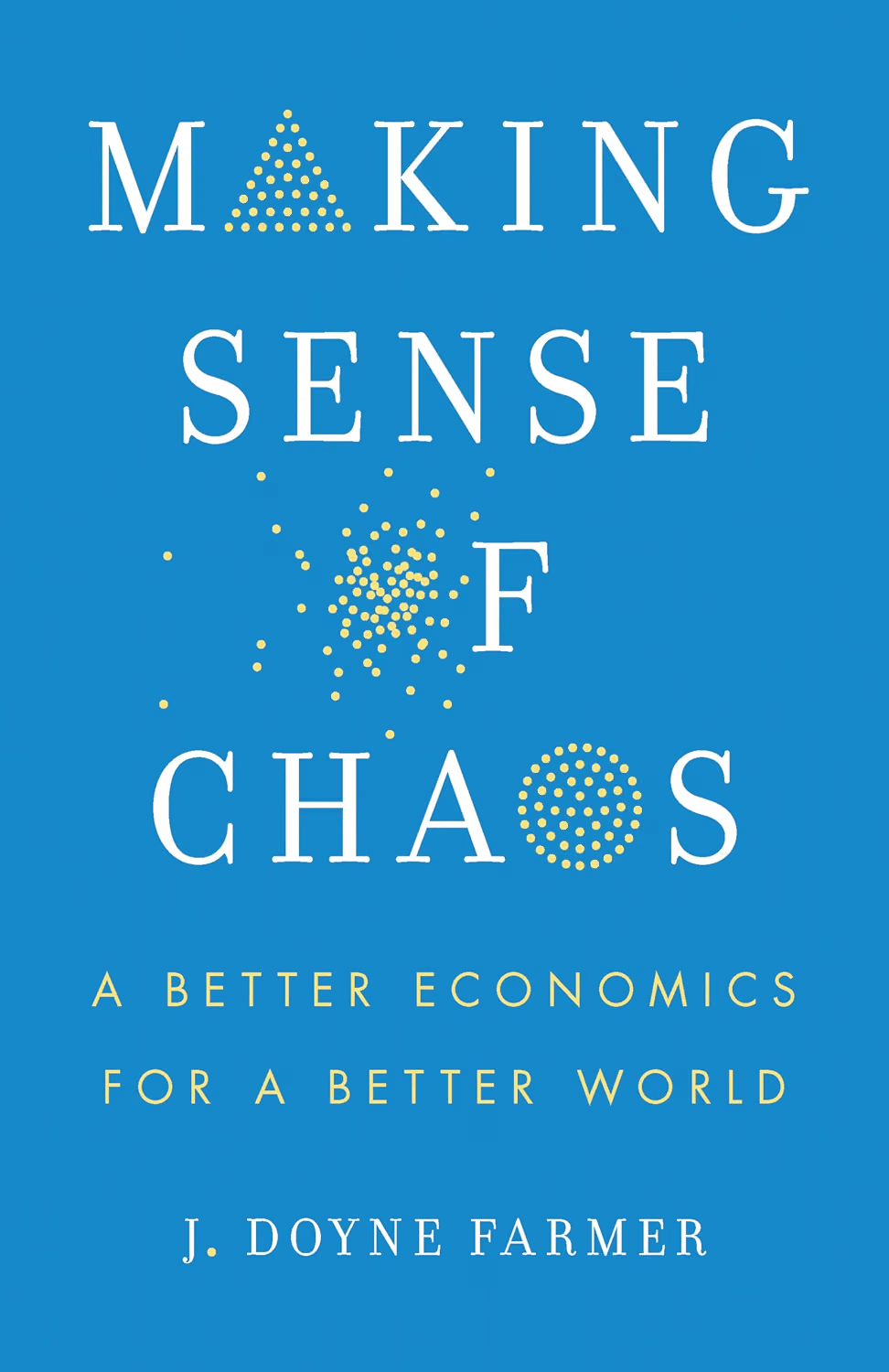
J. Doyne Farmer is a Professor of Complex Systems Science at Oxford University, Hedge-Fund Founder, and author of the new book, Making Sense of Chaos: A Better Economics for a Better World.
Greg and Doyne discuss why complexity science has not displaced mainstream economics. Doyne argues that economics is intellectually conservative and overly committed to closed-form math, with behavioral challenges and the 2008 crisis highlighting endogenous dynamics. He also recounts working to beat roulette using physics, his work on chaos (sensitive dependence, strange attractors), and using simulation as a core complex-systems method.
When they shift to the topic of finance, he describes “market ecology,” specialists with noisy skill, and why even uninformed trades have market impact. Doyne notes bounded rationality’s rise with modern computing and data, critiques systemic regulation, and describes industry-leading simulation work, including COVID UK economic-policy modeling and energy-transition/climate models that emphasize data-driven forecasts and policy nudges.
*unSILOed Podcast is produced by University FM.*
Episode Quotes:
Randomness is a subjective concept
08:50: As graduate students, Norman Packard and I and about 15 or 20 others, decided to predict the game of roulette, and we thought we were going to get rich by beating the game of roulette. And roulette is interesting 'cause it's, from the point of view of a casino, it's a random number generator, or at least it's supposed to be. From a physicist, it's a rolling ball on a circular track with a counter-rotating inner wheel, and that's just physics. And when we realized that 15 seconds elapsed between the time the ball's released and them closing the bets, typically, we realized we had time to gather initial data, make predictions. We bought a roulette wheel. We derived the forces acting on the ball and the wheel, built this all into a computer that we operated with our toes, and we did beat the game of roulette. We didn't really get rich, but it did make me realize that randomness is a subjective concept. To us, it wasn't random. To somebody else, it would be. And looking at things a different way could change that.
What really is complexity
13:34: Complex systems just means any kind of system where you have components that have emergent behavior... [14:08]. The system as a whole exhibits qualitatively different properties from its individual components.
Better models can make systems perform worse
29:02: When you have a system with agents who are modeling their world and acting upon the model, as the models get more sophisticated, the trying to model the whole becomes harder and harder. And, and in some circumstances, the whole system performs worse when everybody has better models because they're too busy trying to outfox the other guys. Now, the economists would say, "Oh, no, but if they're all rational, it all settles into the best solution." Yeah, but we know they aren't. So then you have to really understand the way in which the collective behavior of boundedly rational models causes overshoots and undershoots at the level of the whole economy, and the ways in which, um, what's good for an individual if everybody else is behaving simply can be not good for anybody if everybody does it.