
Episode 650: Nick Chater

May 12th, 2026
Listen to Episode on:


Watch the Unabridged Interview:
Order Books
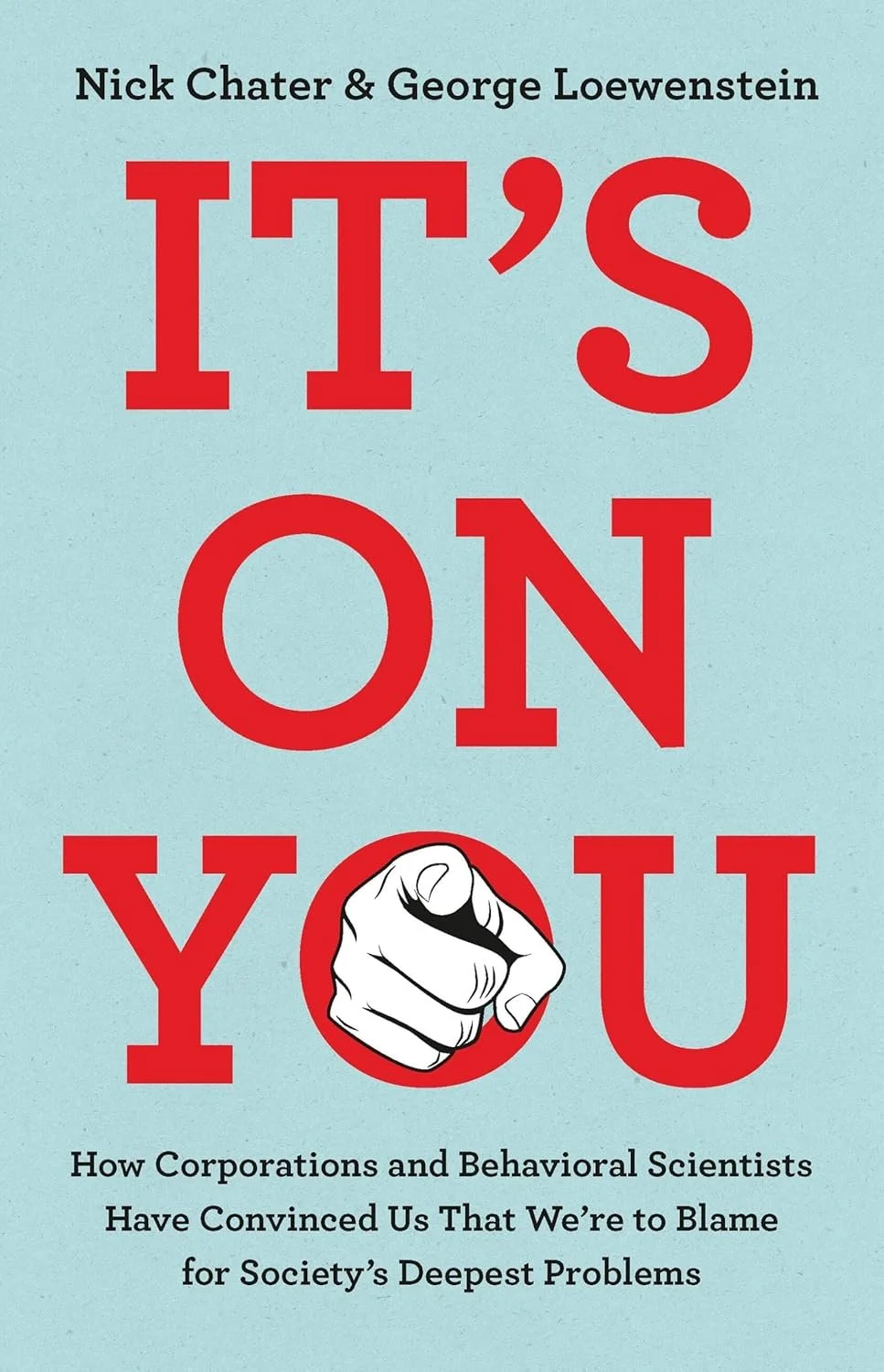


How ‘Nudge’ Policies Shifted the Blame From Systems to Individuals
How much is on us, as individuals, to fix the world’s great problems? Do initiatives like encouraging homeowners to switch to green energy really move the needle in the battle against climate change? After decades of these types of strategies, it turns out that needle hasn’t moved much.
Nick Chater is a professor of behavioral science at Warwick Business School and author. His latest book, co-authored with George Loewenstein, is It's on You: How Corporations and Behavioral Scientists Have Convinced Us That We’re to Blame for Society's Deepest Problems.
Nick and Greg discuss individual frameworks vs. systemic frameworks employed to solve large social problems, why misunderstanding multiple casualties can hinder solutions, and how behavioral insights should be used to design and build support for systemic policies (e.g., carbon taxes, congestion charges) rather than marginal tweaks.
*unSILOed Podcast is produced by University FM.*
Episode Quotes:
The two ways of seeing dilemma
05:07: I think our natural instinct, and this is sort of a basic fact of human psychology, is that we see things either as individual-level problems or as societal-level problems. So it's just a general point that we can't really see things in two ways at once. For example, if we take something like the increasing levels of obesity in the U.S. and the U.K., lots of countries around the world, it's very difficult for us to quite manage the psychology of thinking. Oh, at an individual level, say for me or my family, the interventions that might be appropriate are individual-level things. So I might think, oh, I want to just eat slightly different foods and slightly different amounts of them and exercise a bit more, and so on. And if I'm thinking about it like that, it's very hard to simultaneously think, oh, hang on. But that individual-level story can't really explain why obesity has risen so substantially over the last few decades.
On weaponizing personal responsibility
29:27: If you want to stop your voters and the general public from worrying about these s-frame systemic rule-change things, a really good idea is to focus them on the i-frame. Say, well, wow, this problem is a problem, and it's a problem for individuals. So we need to individually worry about it. And once you're worrying about it individually, then suddenly you've forgotten about the s-frame. You suddenly think, "Oh, I might. I should reduce my carbon, and so should everybody else." In fact, now I can start to blame myself. I can blame my neighbors.
Why marginal tweaks won't fix broken systems
17:51: I've had the experience many times of sitting brainstorming with teams of people where our objective is to think of something to solve, you know, let's improve, let's make accident care, an emergency or ER, I guess, in the US, how to make that, you know, safer and work better. Or how are we going to, are we going to, you know, get people to take more exercise, or whatever the issue is. And we're supposed to be brainstorming these sorts of little nuggets, these little changes, which we are going to hope to roll out. And it just always felt like just a really, you know, the solutions one came up felt incredibly feeble in relation to the scale of the problem.
Show Links:
Recommended Resources:
Guest Profile:
Faculty Profile at Warwick Business School
Professional Profile on LinkedIn
Dectech company website